
A brand replies to your pitch. They want your rates, your audience stats, and “any past campaign results” — by Friday. The numbers are in three apps, the past results are buried in old DMs, and your rate card is, if you’re honest, a guess you made up last time and forgot.
This is the moment most creators lose deals they deserved. Not because the content was wrong — because the business around the content was invisible. Sponsorships are a pipeline: inbound, negotiation, deliverables, payment, follow-up. Run it like one and the Friday email becomes a ten-minute task. Run it from memory and it’s a panic.
The Anatomy of a Brand Deal
Every deal, from a $50 product seeding to a multi-video partnership, moves through the same stages:
- Inbound or outreach. They found you, or you pitched them. Either way: who, when, what they asked for.
- Negotiation. Deliverables, timeline, usage rights, rate. The details that matter live here — and they’re the details most creators forget to write down.
- Agreement. What’s promised, in writing. Even informal deals need a record: what, when, how much.
- Delivery. The content goes out — posts, videos, stories — each tracked against what was promised.
- Payment. Invoice sent, payment received. The stage where most creators’ tracking quietly ends, and where the money quietly leaks.
- Follow-up. Results shared, relationship maintained. The deal that ends well becomes the next deal.
Miss a stage and something breaks: the deliverable nobody tracked, the invoice nobody sent, the follow-up that would have become a retainer. A sponsorship system is just these six stages, visible, with nothing relying on memory.
The Tracker: Sponsors & Deals
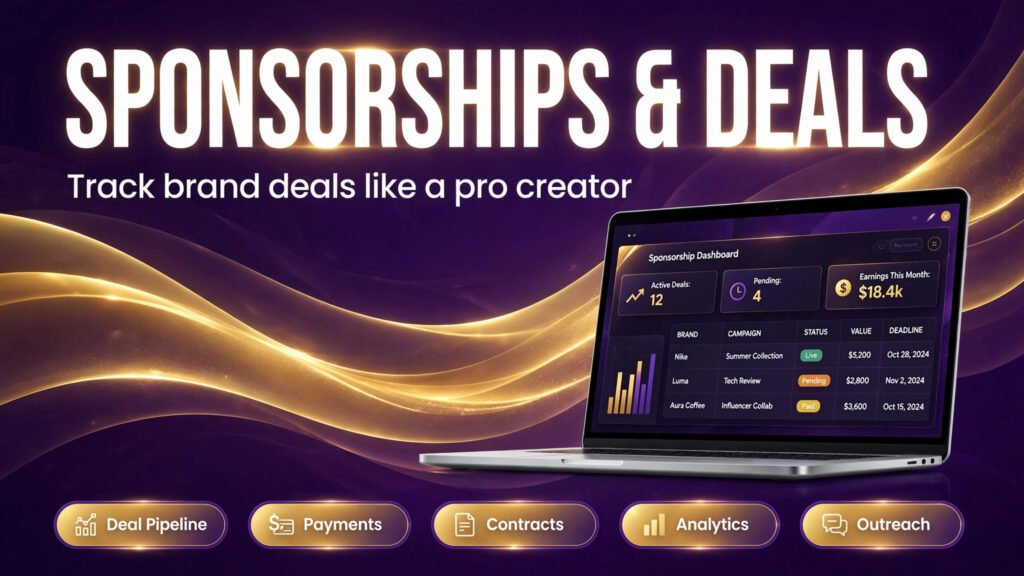
The AI Creator OS ($59 launch, regular $99) includes a dedicated Sponsors & Deals tracker built for exactly this pipeline. Every brand gets a file: contact, deal value, deliverables, deadlines, payment status — each deal moving through the six stages above, so “where are we with them?” always has an answer.
It’s one part of a larger creator system — the content pipeline, the 40-prompt AI vault (which includes outreach and negotiation prompts for the awkward emails), the repurposing engine — but the deals tracker is the part that turns sponsorships from chaos into a pipeline. When the Friday email arrives, you open one page: your stats are there, your past deals are there, your deliverables history is there.
$59 launch (regular $99), one click to duplicate into your free Notion account, 30-day money-back guarantee.
The Proof Layer: Testimonial OS
Here’s what brands actually buy: proof. Not follower counts — evidence that working with you moves something. And most creators’ proof is sitting in old DMs, never collected, never placed.
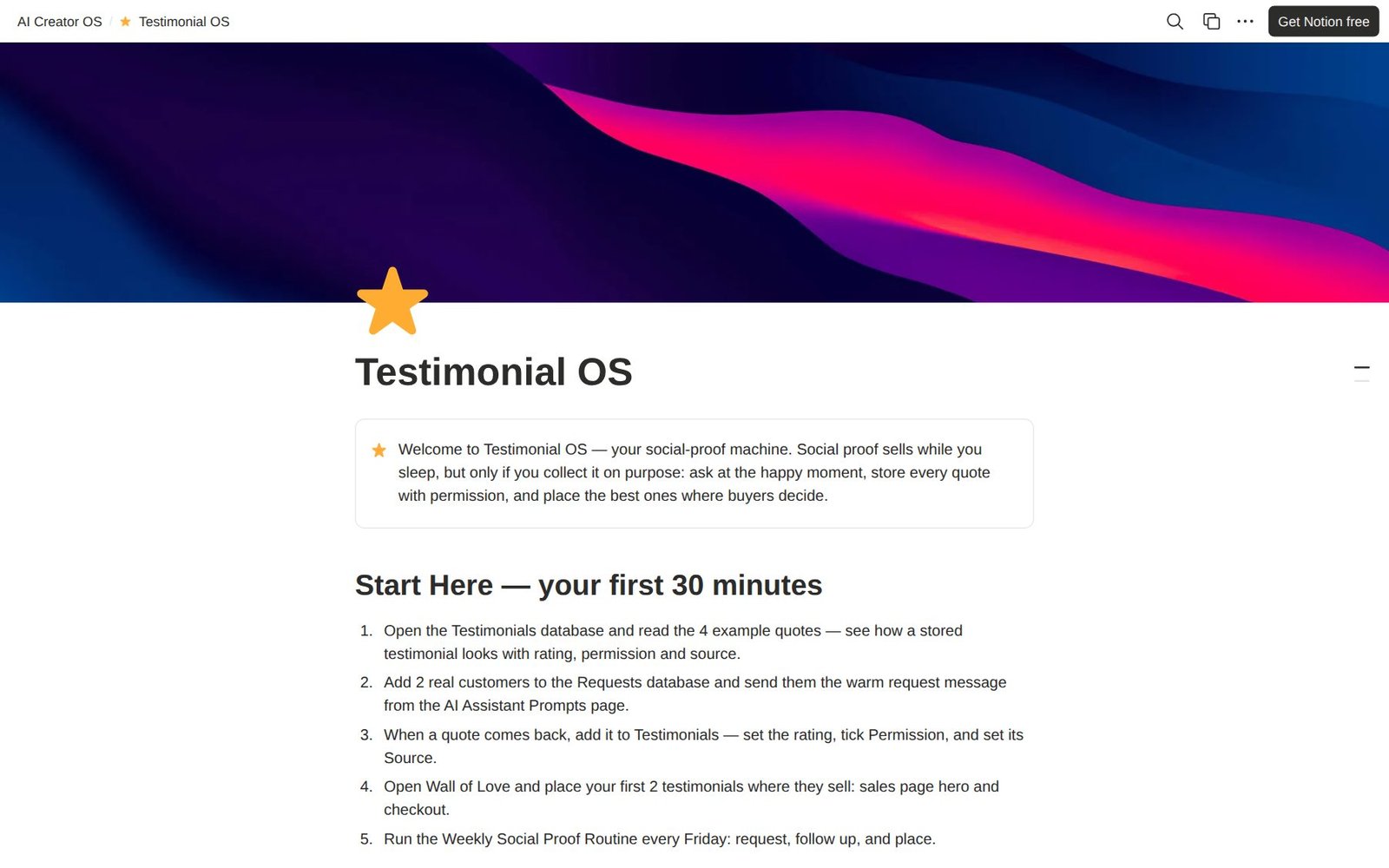
The Testimonial OS ($19) systematises the collection: a request pipeline (To Send → Sent → Replied → Received) for gathering results and quotes, every testimonial stored with a permission tick so you always know what’s usable, and a “Wall of Love” that places the right proof in the right pitch. Past campaign results, client quotes, screenshots of “this worked” — organised, permissioned, ready.
When the brand asks for “any past campaign results,” the answer is a link, not a scroll through eighteen months of DMs.
The Audience Layer: SMM OS + LinkedIn Creator OS
Proof closes deals. Audience opens them. Brands want to know who they’re reaching and whether you’re consistent — and “I’m consistent, trust me” is not a media kit.
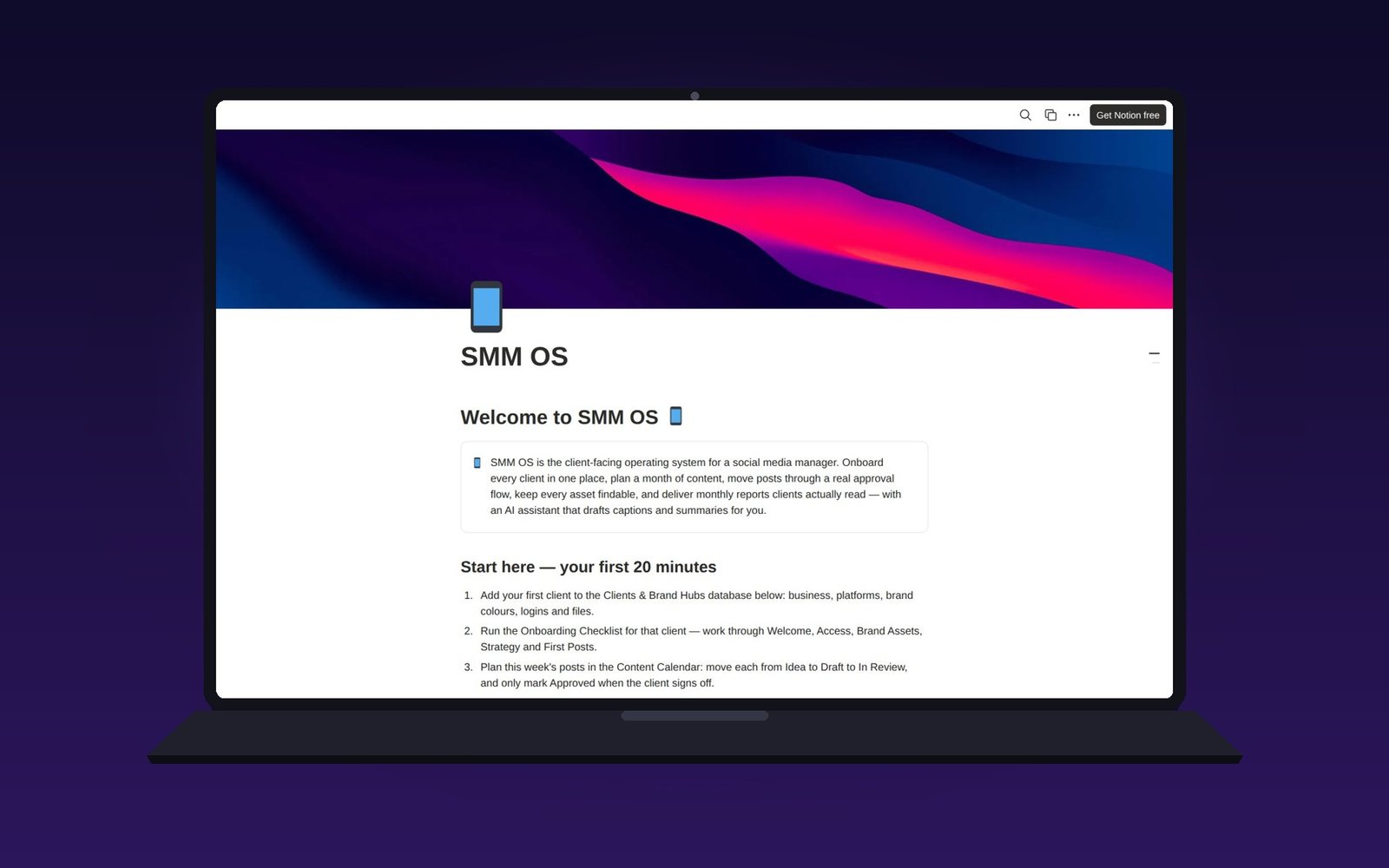
The SMM OS ($29) is the social media management system: content pipeline, posting calendar, and performance tracking across platforms. It’s where your consistency becomes visible — to you first, then to anyone you show it to. A creator who can point to six months of steady output negotiates from a different position than one who can’t.
The LinkedIn Creator OS ($49) covers the professional layer: the LinkedIn content system, the authority-building pipeline, the network that turns into inbound. For B2B creators especially, LinkedIn is where the deals start — and a system for it beats posting when you remember.
Together, these two are the “who am I reaching, and am I serious about it” answer. Not vanity metrics — a visible record of showing up.
Talking Rates Without Guessing
The hardest email in the sponsorship pipeline is the rate email. Here’s how to stop guessing:
- Know your deliverables. Price the work, not the follower count: one video, two stories, usage rights, timeline. When you can list exactly what they get, the number stops feeling arbitrary.
- Track every past deal. What you charged, what was included, how it went. Your own history is the best rate card you’ll ever have — and it’s also the answer to “is this worth it?”
- Separate the negotiables. Rate, deliverables, timeline, usage rights — four separate levers. A brand that can’t move on rate might move on usage rights. Knowing which lever matters to you is negotiating from data, not hope.
- Write it down before you reply. The deal terms, in your tracker, before the email goes out. Future-you — the one chasing payment in six weeks — will be grateful.
No system can tell you what to charge. But a system can make sure you never again answer the rate question from a blank page and a vague memory.
Two habits make the biggest difference. First, say the number first — in the negotiation, whoever names a number anchors the conversation. Creators who wait to be told a budget almost always get a lower one than creators who open with their rate. Second, track rejections as data, not verdicts. Every “too expensive” and every “not right now” goes in the tracker with the number you quoted. After twenty data points, you know your market better than any pricing guide could tell you — because it’s your market, not someone else’s.
The Outreach Email That Gets Answered
Most pitch emails fail before the second sentence. The brand’s partnerships inbox gets dozens a day, and most of them are either a life story or a rate card with no context. The ones that get answered follow a simple structure:
- Who you are, in one line. Not your bio — your relevance. “I make [content type] for [audience]” is enough. If they can’t place you in ten seconds, they won’t place you at all.
- Why this brand, specifically. One sentence that proves this isn’t a mass email. The product you actually use, the campaign you noticed, the audience overlap you can name. Specificity is the difference between a pitch and spam.
- What you propose, concretely. Not “a collaboration” — one video plus two stories, or a dedicated review, or a month-long series. Concrete proposals are easy to say yes to; vague ones are easy to ignore.
- Proof, linked. One link to past results or your best work. Not five links, not an attachment — one.
- One clear ask. “Open to a 15-minute call next week?” A pitch that ends without an ask ends, full stop.
The whole email is under 150 words. Short pitches respect the reader’s time, and respected time gets replies. The AI Creator OS vault includes outreach prompts for exactly this — the awkward first email, the follow-up when they don’t reply, the “just checking in” that doesn’t sound desperate. The structure above is the strategy; the prompts are the words.
And the follow-up matters as much as the pitch: most deals happen on the second or third touch, not the first. That’s a pipeline job — the email goes in the tracker with a follow-up date, and the system reminds you. “Just following up” sent at the right time has closed more deals than any brilliant first email.
The Four Tools, Compared
| Tool | What It Holds | Price |
|---|---|---|
| AI Creator OS | Creator system incl. Sponsors & Deals tracker: pipeline, deliverables, payments + 40 AI prompts | $59 (reg. $99) |
| Testimonial OS | Proof layer: testimonial requests, permissions, Wall of Love | $19 |
| SMM OS | Audience layer: content pipeline, calendar, performance tracking | $29 |
| LinkedIn Creator OS | Professional layer: LinkedIn content system, authority pipeline | $49 |
And if you want the whole library rather than choosing: the All-Access Bundle ($149 launch, regular $199) includes all 48 products in the store — a $1,334 value — plus 1,140 AI prompts, in one purchase.
For the wider freelance picture — clients, invoices, projects beyond sponsorships — the companion guide is Best Notion Templates for Freelancers and Agencies.
The Weekly Deals Routine
Sponsorships compound with a rhythm. Fifteen minutes, once a week:
- Pipeline glance (5 min). Every active deal: what stage, what’s next, what’s stuck.
- Money check (5 min). Invoices sent versus paid. Anything overdue gets its follow-up today — the AI vault has the payment reminder prompt.
- One outreach (5 min). One pitch, one follow-up, one relationship email. The pipeline only fills if you feed it.
That’s it. The deals you track are the deals you close; the ones in your head are the ones that evaporate.

Frequently Asked Questions
How do I get my first brand deal? Start with proof and consistency: collect every result and kind word with Testimonial OS, keep a visible posting rhythm with SMM OS, then pitch brands you already use. Small, relevant beats big and random — and the AI Creator OS outreach prompts handle the awkward first email.
What do brands actually look at? Fit, consistency, and proof — in that order. Do you reach their audience, do you post reliably, and can you show past work that did something. Follower count matters less than most creators think; a tidy record of all three matters more.
How do I track payments without it becoming a second job? The Sponsors & Deals tracker in AI Creator OS has payment status per deal — invoice sent, paid, overdue — and the weekly routine catches anything slipping. Five minutes a week beats a monthly panic.
Do I need a media kit? Eventually, yes — but a system comes first. A media kit is a snapshot; the tracker, the proof wall and the performance record are the living source it draws from. Build the system, and the media kit writes itself.
The Quiet Part
Creators don’t lose sponsorships because their content isn’t good enough. They lose them in the gaps: the unanswered follow-up, the untracked deliverable, the invoice sent three weeks late, the proof that existed but couldn’t be found.
Build the pipeline: the AI Creator OS ($59) for the deals tracker, Testimonial OS ($19) for the proof, SMM OS ($29) and LinkedIn Creator OS ($49) for the audience layer. Run the fifteen-minute weekly routine. The Friday email becomes the easiest email of your week.