

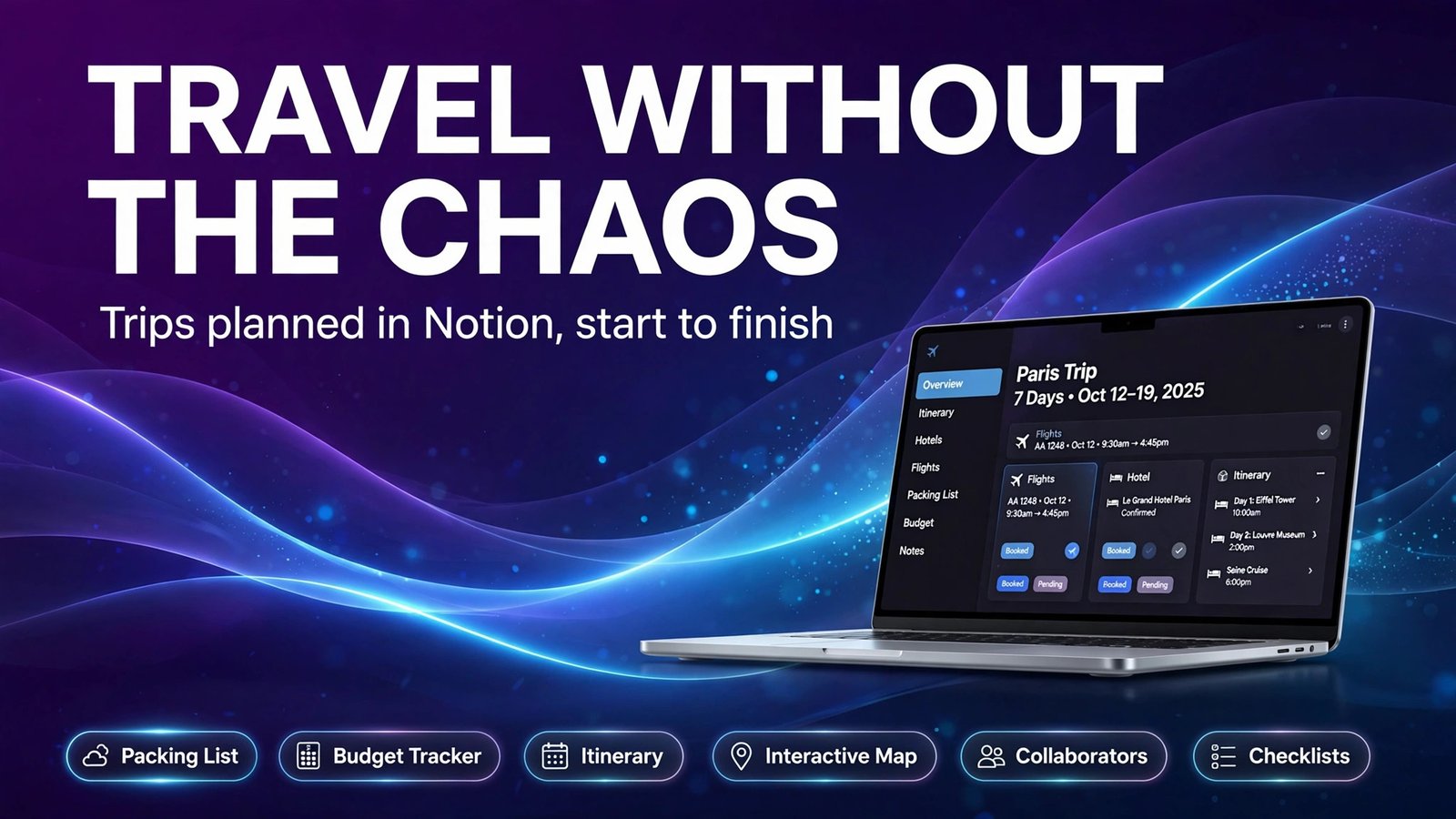
It’s the night before the flight. Your boarding pass is in an email somewhere, the hotel confirmation is in a different email, the day-by-day plan is a half-finished note in your phone, and your bag is still… aspirational. You’ve taken this trip twice already — once in your head, once in twelve browser tabs — and somehow the actual packing hasn’t started.
The trip isn’t the problem. Trips are fun. The problem is that every trip is actually a small project, and projects fall apart when their information lives in seven places at once.
A travel planner template doesn’t make you a different person. It gives the trip one home — the itinerary, the bookings, the budget, the packing list — so the night-before scramble stops being a tradition.
Why Trips Fall Apart Before They Start
Let’s be honest about what actually goes wrong. It’s almost never the flight or the hotel. It’s the small, boring stuff:
- The itinerary lives in your head. You “know” the plan — until day two, when nobody remembers what time the museum opens or where the rental car pickup is.
- Confirmations are archaeological. Boarding passes, hotel bookings, tour tickets: buried across email, SMS, and three apps, each retrievable only through a panicked search at the airport.
- The budget is a vibe. You meant to spend sensibly. Then day three arrives and you have no idea what you’ve spent, so you either panic-freeze or stop checking entirely.
- Packing is last-minute improv. The charger gets remembered at 30,000 feet. The adapter gets remembered at the hotel. The second pair of shoes gets remembered never.
- Nobody knows the plan but you. If you’re travelling with anyone — partner, kids, friends — the whole trip is bottlenecked through your memory.
Each of these is an information problem. And information problems are exactly what a good template solves: one place, everything findable, nothing relying on memory.
The Three Layers of Trip Planning
Every trip, from a weekend city break to a three-week adventure, has the same three layers. Get all three into one system and the trip runs itself.
Layer 1 — The itinerary. Where you are, day by day. Not a minute-by-minute schedule — a loose skeleton: travel days, stay days, the two or three things per day that actually matter. The itinerary answers “what’s happening today?” at a glance.
Layer 2 — The logistics. The bookings behind the itinerary: flights, hotels, trains, tours, restaurants. Each with its confirmation code, its time, its price, and — critically — retrievable in seconds when someone at a counter asks for it.
Layer 3 — The packing. What goes in the bag, checked off as it goes in. Plus the pre-trip chores nobody thinks about: documents, home prep, the plants, the mail.
Most people plan layer 1 in their head, scatter layer 2 across email, and improvise layer 3 at midnight. The fix is putting all three where you can see them.
Travel Planner OS: The Full System
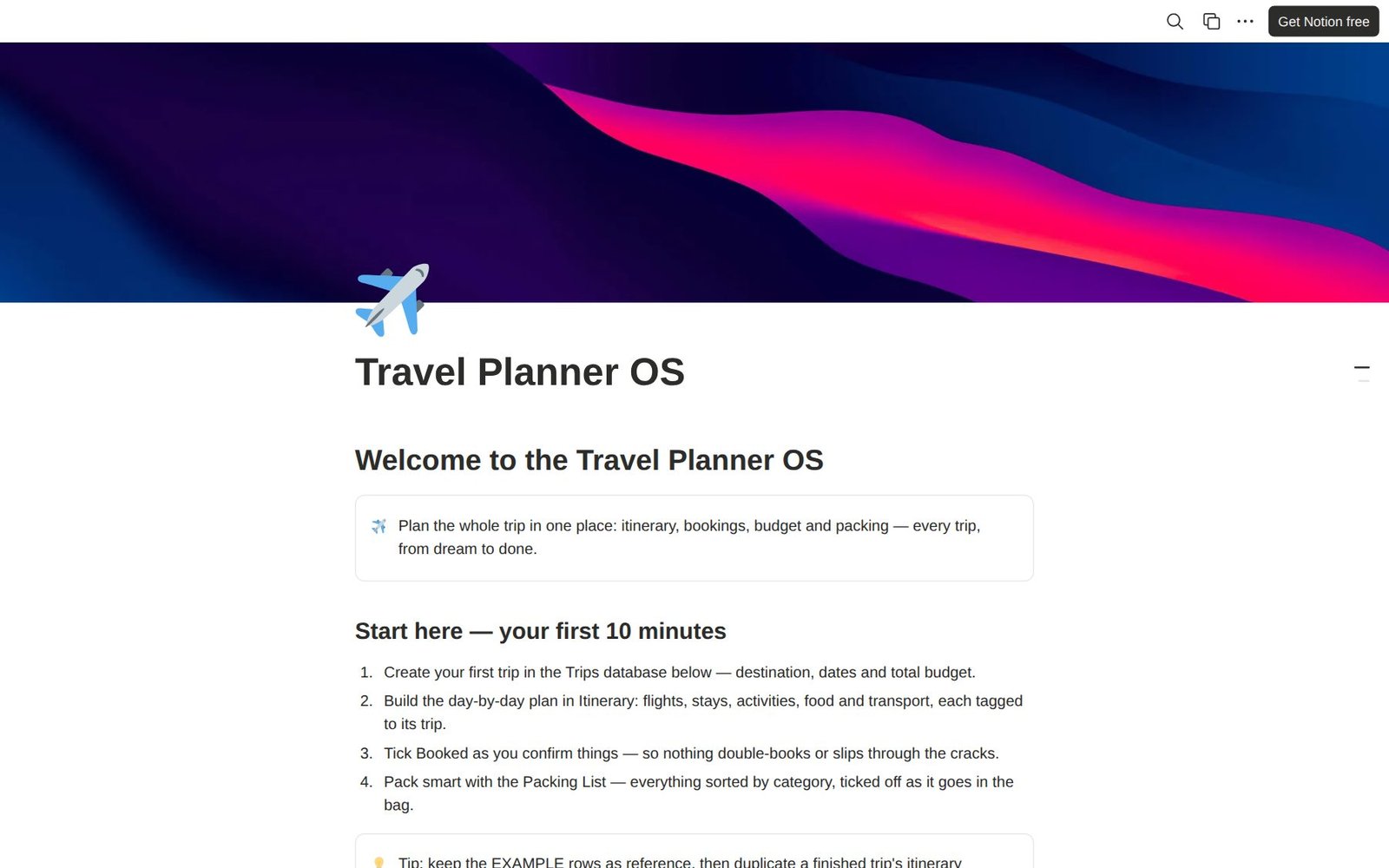
The Travel Planner OS ($9) is the complete version — a Notion workspace where all three layers live together.
Every trip gets its own page with dates, destination, budget and status — upcoming, in progress, done. Inside, the trip breaks down the way trips actually work:
- Day-by-day itinerary — each day with its plan, so “what are we doing Thursday?” has an answer that isn’t your memory.
- Bookings tracker — flights, hotels, trains, tours, each with confirmation codes, times and costs. When the airline asks for your booking reference, it’s one click away, not a 10-minute email search.
- Budget tracker — planned versus actual spending per trip, so the “what have we spent?” question gets a real number on day three instead of a guess on day ten.
- Packing lists — per-trip packing with checkboxes, reusable across trips so you’re not rebuilding the list from scratch every time.
- Travel notes — the restaurant recommendation from a friend, the “don’t miss this” from a blog, the address of the place you’re staying. Everything worth keeping, kept.
It’s $9, it duplicates into your Notion in one click with a free account, and it carries the 30-day money-back guarantee like everything in the store. If you take even two trips a year, the booking-tracker alone earns it back the first time you need a confirmation code in a hurry.
Start Free: The Two Starters
Not ready to buy anything? You don’t have to. There are two free templates that cover the two most useful slices — and they’re genuinely free, not demos.
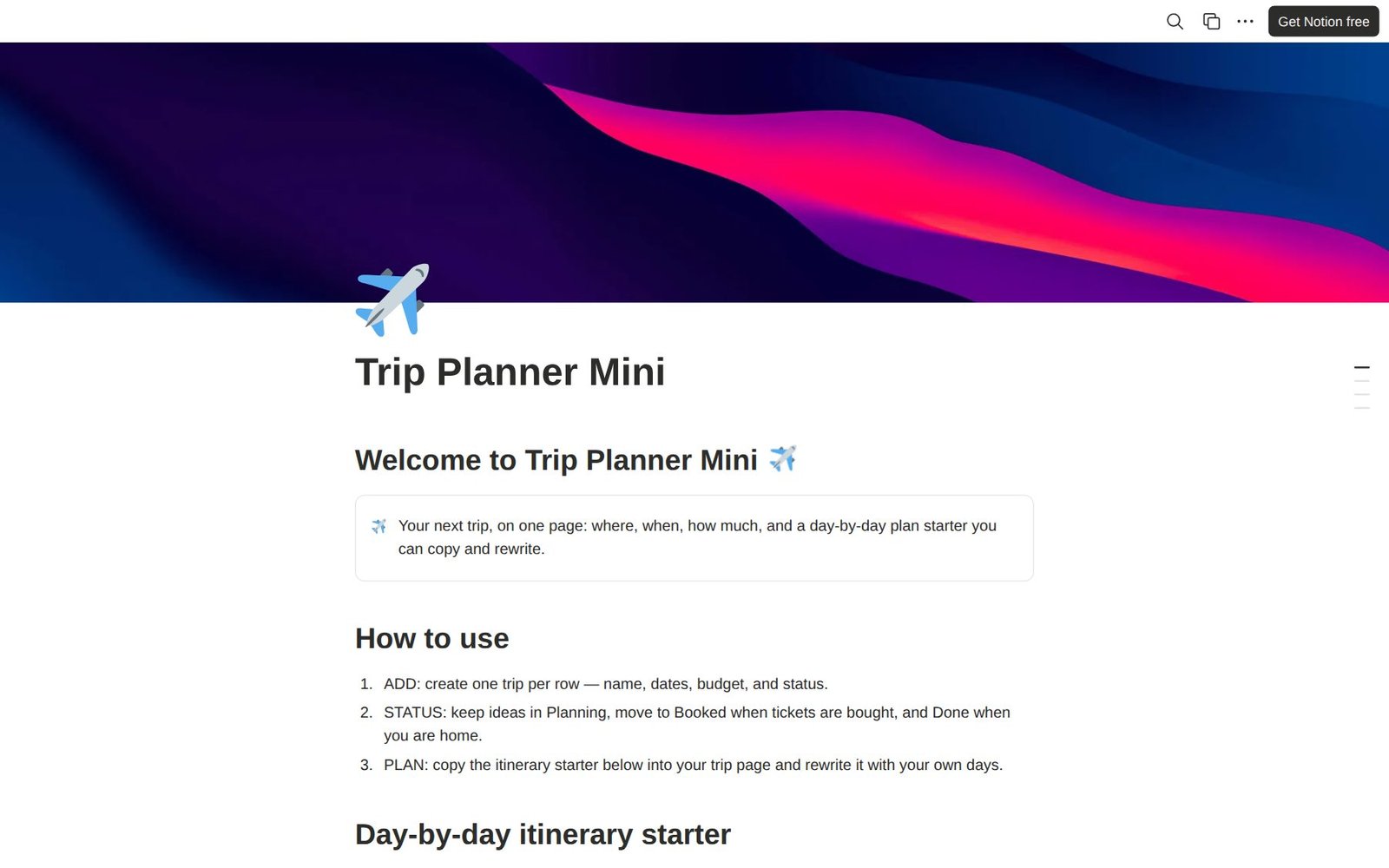
The Trip Planner Mini is a free Notion starter for the itinerary layer: every trip with its dates, budget and status, plus a sample 3-day itinerary you can steal and reshape for your own plans. Three example trips come pre-filled, so you see how it works before you type a word — replace them with yours and start dreaming.
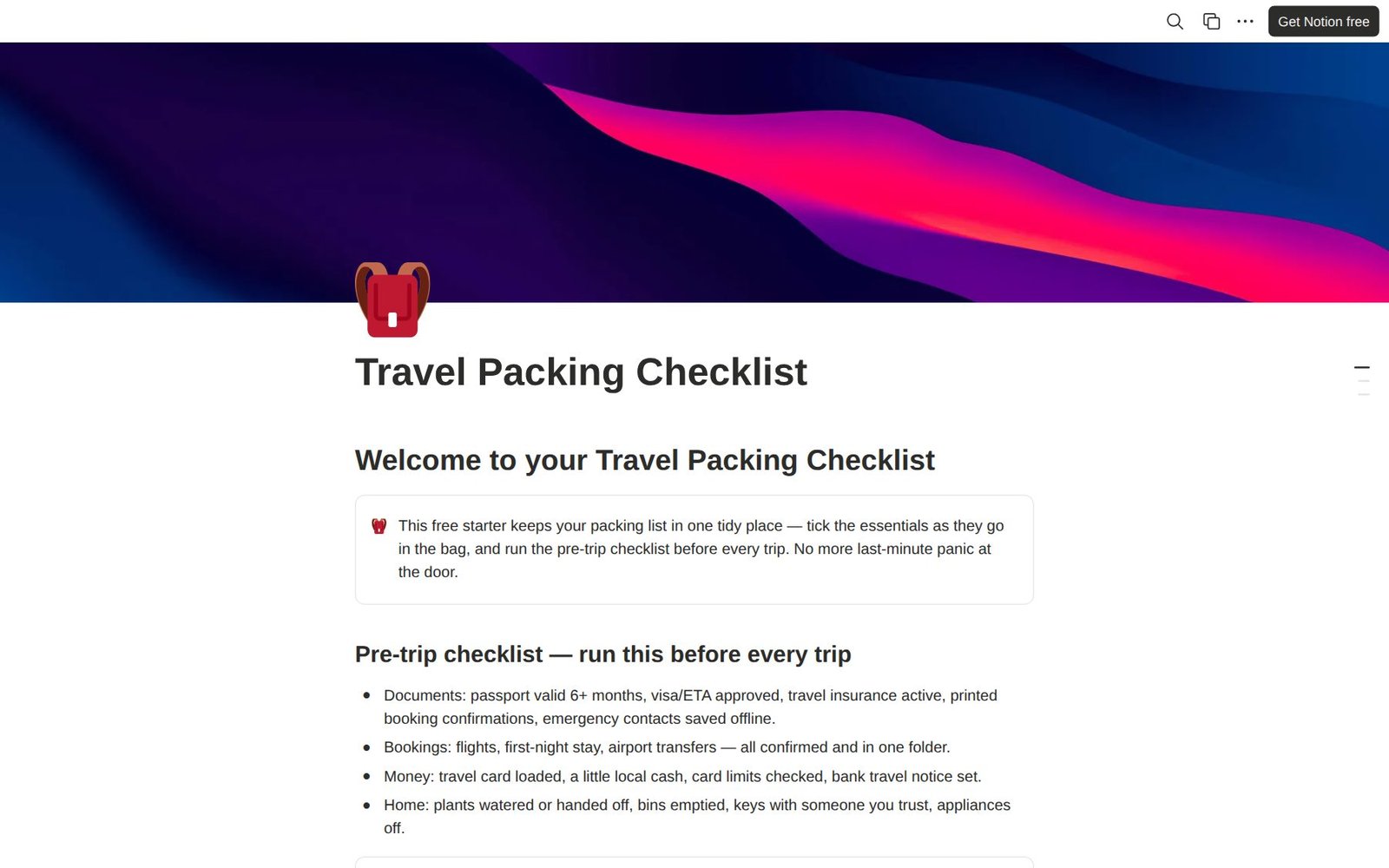
The Travel Packing Checklist is the free answer to the midnight-packing problem: a packing list database you check off item by item, plus a pre-trip checklist covering documents, bookings and home prep — the “turn off the water heater, hold the mail, charge everything” layer that gets forgotten in the excitement. One template, zero travel anxiety.
The honest guidance: start with the two free ones. If you find yourself wanting the bookings tracker and the budget layer too, that’s what the $9 Travel Planner OS adds. The free tools aren’t crippled versions — they’re complete for what they do.
The Pre-Trip Timeline That Actually Works
Whatever tool you use, run the trip on a timeline. Here’s the one that works:
Four weeks out — the skeleton. Destination, dates, the big bookings (flights, first hotel). Put them in the template the day you book. This is also when the itinerary gets its loose shape: which cities, how many nights, the non-negotiable experiences.
One week out — the details. Fill in the day-by-day plan. Add remaining bookings — tours, restaurants, transport. Check documents: passport validity, visas, travel insurance, the credit card that doesn’t charge foreign fees. Start the packing list — add things as you think of them all week.
The night before — the sweep. Run the pre-trip checklist: documents, chargers, home prep. Check off the packing list as things go into the bag. Look at day one’s plan once. Then stop planning — the system holds it now.
The magic of the timeline isn’t discipline. It’s that each stage has a bounded job, so planning never becomes an endless background worry. You do the week’s work, and the template remembers the rest.
The Packing System (Steal This)
Packing fails for one reason: it’s done from memory, under time pressure. Here’s the system that fixes it — five categories, packed in order:
- Documents. Passport, ID, bookings, insurance. This pile gets packed first and checked twice, because everything else is replaceable and this isn’t.
- Tech. Charger, cables, adapter, headphones, power bank. The “did I pack the charger” anxiety disappears when tech has its own checklist line.
- Clothes by formula. Not “outfits” — a formula: tops = days + 1, bottoms = days ÷ 2, one layer for the coldest expected evening, one pair of shoes beyond what you’re wearing. Formulas beat inspiration at midnight.
- Toiletries and meds. The small bag. Anything you take daily goes here, packed the night before, never the morning of.
- Day bag. What you need on travel day itself: snacks, water, entertainment, the documents pouch. Packed last, carried on.
Two tricks make this stick. First, the launch pad: one corner of one room where everything for the trip accumulates all week. See it, add to it, pack from it. Second, check off as you pack — not before. The checkbox means “in the bag,” not “thought of.” And the photo trick: snap a photo of the open packed bag. If your luggage goes missing, that photo is worth more than any list when you’re describing contents.
The Three Options, Compared
| Template | What It Covers | Price |
|---|---|---|
| Travel Planner OS | Full trip system: itineraries, bookings tracker, budget, packing lists, travel notes | $9 |
| Trip Planner Mini | Free starter: trips with dates, budget, status + sample 3-day itinerary | Free |
| Travel Packing Checklist | Free starter: packing list database + pre-trip checklist (documents, bookings, home) | Free |
And if you’d rather have the whole library in one go: the All-Access Bundle ($149 launch, regular $199) includes all 48 products in the store — a $1,334 value — plus 1,140 AI prompts, in one purchase.
How to Set It Up Tonight
If there’s a trip on your horizon — even a vague one — set it up now, while the motivation is warm:
- Duplicate the template (2 minutes). Open the link, click Duplicate, it’s in your Notion. Free account is all you need — just be logged in to see the Duplicate button.
- Add your next trip (10 minutes). Destination, dates, the bookings you already have. Don’t aim for complete — aim for started.
- Steal the sample itinerary (10 minutes). If you’re using the free Mini, take the 3-day sample and reshape it. It’s easier to edit a plan than to face a blank page.
- Start the packing list (5 minutes). Add the obvious things now. You’ll add more all week as they occur to you — that’s the system working.
Twenty-five minutes, and the next trip has a home. The night-before version of you will be grateful.
Frequently Asked Questions
Do I need a paid Notion account to use these travel templates? No. A free Notion account is enough for all of them — open the template link, click Duplicate, and it copies into your workspace. You just need to be logged in to see the Duplicate button.
What’s the difference between the free Mini and the $9 Travel Planner OS? The free Trip Planner Mini covers trips, dates, budgets and a sample itinerary. The paid Travel Planner OS adds the bookings tracker with confirmation codes, the planned-vs-actual budget layer, reusable packing lists and travel notes. If you only take simple trips, the free one may be all you need.
Can I share the trip plan with travel companions? Yes — that’s one of Notion’s strengths. Share the trip page with your partner or friends and everyone sees the same itinerary, instead of the plan living in one person’s head and everyone else asking “so what are we doing today?”
What if I buy the paid version and don’t like it? Every template in the store carries a 30-day money-back guarantee — if the system isn’t for you, email within 30 days for a full refund. No forms, no hard feelings.
The Quiet Part
Nobody remembers the trips that went smoothly. They remember the ones where the plan lived in one calm place and the travelling felt like travelling — not like project management with better views.
Pick the layer you need: the free Trip Planner Mini for the itinerary, the free Travel Packing Checklist for the bag, or the full Travel Planner OS ($9) when you want bookings, budget and everything in one workspace. Set it up tonight, while the next trip is still exciting.